Insulation is the first line of defence in any cable, and even a tiny pinhole can become a serious failure once the cable is installed. At Puretronics, we build a complete range of spark Testers for the cable extrusion process, designed to check the insulation quality of every metre of wire as it is produced. Our goal is simple: help you find defects on the line, not in the field.
How Our Spark Tester Works
The principle behind a spark tester is simple, but the results are powerful. Dry cables run through an electrode and are exposed to a high voltage set by the operators. If the insulation is intact, nothing happens. If there is a pinhole, crack, or thin spot, the electrical field breaks down and the fault is detected instantly. Based on its sensitivity and voltage setting, the device registers and counts each fault, so defects are caught in real time rather than after the cable reaches your customer.
Three Types For Different Applications
Not every cable needs the same test, which is why we offer three variants of our spark tester.
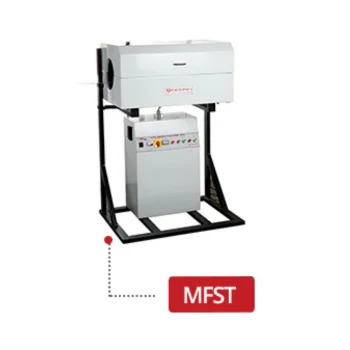
MFST (Mains Frequency Spark Tester)
Operating at 50/60 Hz, the MFST covers a voltage range of 1.5 to 15, 25, or 40 kV. It handles wire sizes from 0.5 to 40 mm outer diameter (60 mm on demand) at speeds up to 200 metres per minute, making it a strong fit for thicker power and control cables.
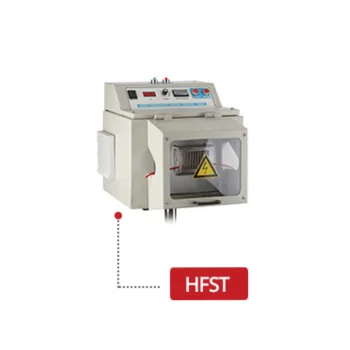
HFST (High Frequency Spark Tester)
Working at 2.5 to 3.5 kHz with a 10 or 15 kV range, the HFST uses a MOSFET-based sine wave low-power circuit. It supports wire from 0.5 to 15 mm at speeds up to 1,200 metres per minute, ideal for fast-moving thin-wire lines.
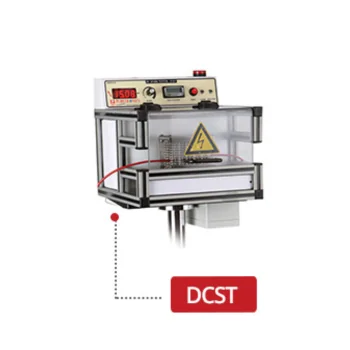
DCST (DC Spark Tester)
Covering 1.5 to 15 or 25 kV, the DCST also runs at up to 2,500 metres per minute. It is compact, robust, and easy to install, with a 15 kV model weighing under 8 kg. It is built for fast fault detection and easy pinhole identification.
Features That Make Testing Easier
Every spark tester in our range is built with the operators and the QC team in mind:
- Conforms to major industry standards
- All-digit digital display for the high-voltage readouts
- 6-digit self-powered LCD fault counter
- Two change-over relay outputs for machine interlocks
- Door interlocking for operator safety
- Optional fault vs length graph and data logging
- Adjustable-height stands, available for the HFST and DCST, to match different machines
The optional data logging features are especially useful. Instead of simply knowing a fault occurred, your team can see where along the cable length it happened, making root-cause analysis far faster.
Where It Fits On Your Production Line
Our spark tester integrates easily into a range of setups, including online extrusion insulation testing, online rewinding and testing machines, online coiling machines, and standalone inspection machines. It is used across a wide variety of products, including power cable, control cable, telephone cable, LAN cable, RF cable, automotive wire, and building wire.
Why Manufacturers Choose Puretronics
A dependable spark tester does more than find defects. It reduces rejection rates, cuts material wastage, and gives you confidence that every metre shipped meets specification. It also supports better process control, since fault data can be tracked and acted on rather than guessed at.
As An ISO 9001:2015 Certified Company
We build every instrument to perform consistently on real production floors. Setup and operations are kept simple, so your operators can run the equipment efficiently without lengthy training, and routine maintenance stays straightforward.
To keep results accurate over time, we also offer a Spark Tester Sensitivity Calibrator, allowing you to verify performance in-house rather than relying on outside services.
Choosing The Right Model
The right choice depends on your cable diameter, insulation thickness, material type, and line speed. A thick power cable running at moderate speed has very different needs from a thin wire on a high-speed line. Our team works with you to understand your process and recommend the configuration that fits, rather than a one-size-fits-all setup.
If you are looking to strengthen insulation quality control on your extrusion line, get in touch with the Puretronics team. We will help you find the spark tester that matches your applications and keep your production running with confidence.
Frequently Asked Questions
A spark tester for cables is widely used in cable manufacturing to detect insulation faults in real time. Below are some common questions related to spark testing, working principles, and applications.
A spark tester for cables is a high-voltage testing device used to detect insulation defects during cable manufacturing. It works by creating an electrical field around the cable, where any flaw in insulation results in a spark discharge that is immediately detected.
A spark tester works by passing the insulated cable through a high-voltage electrode. If the insulation is intact, no reaction occurs. If there is a defect such as a pinhole or crack, the electrical field breaks down and generates a spark, which is detected and recorded in real time.
The voltage used in spark testing depends on the cable diameter, insulation thickness, and material type. Typically, spark testers operate in the range of 1.5 kV to 40 kV for different cable applications including LT and HT cables.
There are three main types of spark testers for cables:
- AC Spark Tester (Acute Spark Tester) - used for detecting micro defects in wires
- DC Spark Tester - suitable for multi-core cables and stable testing
- High Voltage / Live Spark Tester - used for LT and HT cable testing
Each type is selected based on application and production requirements.
Spark testing is important because it ensures insulation integrity, prevents electrical failures, reduces material wastage, and improves overall product quality. It also enhances safety by detecting defects before cables are installed in real-world applications.
Yes, spark testers are highly sensitive and can detect microscopic defects such as pinholes, cracks, and weak insulation points that are not visible through manual inspection methods.
AC spark testers generate a corona effect and are ideal for detecting very fine defects, while DC spark testers do not produce heat and are better suited for testing multi-core cables and larger insulation structures.
Spark testers are also used in:
- Wire manufacturing
- Corrugated pipes
- Medical tubing
- Industrial insulation products
They are useful wherever surface integrity and insulation quality are critical.
No, when used with the correct voltage settings as per industry standards, spark testing does not damage cable insulation. Proper calibration ensures accurate defect detection without affecting product quality.
Using a spark tester for cables provides multiple benefits:
- Real-time defect detection
- Improved product quality
- Reduced rejection rates
- Enhanced safety
- Better process control through digital monitoring
They are useful wherever surface integrity and insulation quality are critical.
A spark tester checks the insulation quality of every metre of wire as it is produced. The dry cable passes through an electrode and is exposed to a high voltage set by the operator. If the insulation is intact, nothing happens. If there is a pinhole, crack, or thin spot, the electrical field breaks down and the fault is detected instantly. Depending on the sensitivity and voltage settings, the device registers and counts each fault, so defects are caught on the line rather than after the cable reaches the customer.
Three variants are offered, each suited to different cables and line speeds:
- MFST (Mains Frequency Spark Tester): operates at 50/60 Hz with a voltage range of 1.5 to 15, 25, or 40 kV. It handles wire from 0.5 to 40 mm outer diameter (60 mm on demand) at speeds up to 200 metres per minute, making it well suited to thicker power and control cables.
- HFST (High Frequency Spark Tester): works at 2.5 to 3.5 kHz with a 10 or 15 kV range, using a MOSFET-based sine wave low-power circuit. It supports wire from 0.5 to 15 mm and is ideal for fast-moving thin-wire lines.
- DCST (DC Spark Tester): covers 1.5 to 15 or 25 kV and runs at up to 2,500 metres per minute. It is compact, robust, and easy to install, and the 15 kV model weighs under 8 kg.
The right choice depends on your cable diameter, insulation thickness, material type, and line speed. A thick power cable running at moderate speed has very different needs from a thin wire on a high-speed line. Our team reviews your process and recommends the configuration that fits, rather than a one-size-fits-all setup.
Every spark tester is designed with the operator and QC team in mind:
- Conformity with major industry standards
- All-digit digital display for the high-voltage readout
- 6-digit self-powered LCD fault counter
- Two change-over relay outputs for machine interlocks
- Door interlocking for operator safety
- Adjustable-height stands, available for the HFST and DCST
- Optional fault vs length graph and data logging
Without logging, you only know that a fault occurred. With the optional fault vs length graph and data logging, your team can see exactly where along the cable length each fault happened. This makes root-cause analysis much faster, because repeated faults at the same position or interval can be traced to a specific stage of the process. Fault data can then be tracked and acted on rather than guessed at.
It fits into a range of setups, including online extrusion insulation testing, online rewinding and testing machines, online coiling machines, and standalone inspection machines. It is used for power, control, telephone, LAN, RF, automotive, and building wire. To keep results accurate over time, Puretronics also offers a Spark Tester Sensitivity Calibrator, so you can verify performance in-house instead of relying on outside services. As an ISO 9001:2015 certified company, we build each instrument for consistent performance, with simple setup and straightforward routine maintenance.