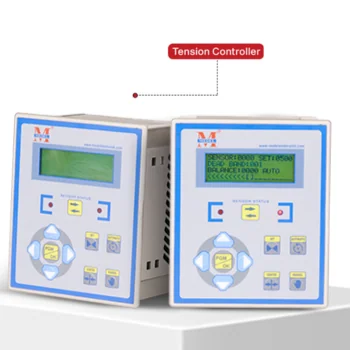
Walk onto any production floor running continuous material, wire, film, fabric, paper, foil, and you'll notice something interesting: the best-run lines are rarely the ones with the most advanced machinery. They're the ones where tension stays quietly, consistently correct, without an operator hovering over it every few minutes. That consistency doesn't happen by chance. It happens because of a Web Tension Controller doing its job in the background, adjusting constantly so no one has to.
The Manual Adjustment Trap
Before automated tension control became standard, operators relied on experience and instinct, tightening here, loosening there, reacting to what they saw rather than preventing what was about to happen. The problem with this approach isn't that it's wrong, it's that it's reactive. By the time a visible issue shows up, the material has already been affected. A Web Tension Controller flips this relationship. Instead of reacting to a problem after it appears, it continuously monitors tension and makes micro-adjustments in real time, correcting deviations before they ever become visible defects.
This shift, from reactive correction to continuous control, is often the single biggest improvement a production line can make without touching the core machinery at all.
A Problem That Isn't Industry-Specific
It's tempting to think of tension control as a niche concern for one type of manufacturing, but the truth is far broader. Any process involving continuous unwinding, winding, or feeding of material depends on stable tension to function properly. A Web Tension Controller solves the same underlying challenge across a wide range of industries:
- Printing and Converting: maintaining accurate registration across high-speed printing and laminating runs
- Textile: preventing fabric distortion during weaving, dyeing, and finishing processes
- Packaging: keeping films and wraps aligned through cutting and sealing operations
- Paper and Corrugation: avoiding wrinkling or tearing across long, continuous feeds
- Rubber Processing: managing tension on flexible, stretch-prone materials
- Metal Industry: maintaining dimensional accuracy during strip and foil processing, where tolerances are extremely tight
In every one of these settings, the goal stays the same: keep material moving smoothly and consistently, regardless of speed changes, material variation, or roll diameter shifts that naturally occur during a production run.
Why Roll Diameter Changes Are The Real Challenge
One detail that often gets overlooked is how tension requirements shift as a roll winds or unwinds. As diameter changes, the force needed to maintain tension changes with it, something a fixed, manually set brake or clutch simply can't account for. This is where a properly functioning Web Tension Controller proves its value most clearly, continuously recalculating and adjusting force as conditions change throughout the run, rather than holding a static setting that becomes less accurate as the roll progresses.
Without this kind of continuous adjustment, operators are left compensating manually, which means more downtime spent on fine-tuning and more inconsistency between the start and end of a roll.
The Hidden Cost Of Inconsistent Tension
Manufacturers rarely attribute quality issues directly to tension control, because the symptoms show up elsewhere, uneven winding, misalignment, material waste, or increased rejection rates during inspections. These get investigated as material problems, machine calibration issues, or operator error, when the actual root cause was tension drifting outside the ideal range. A dependable Web Tension Controller removes this blind spot, giving manufacturers consistent, measurable control instead of leaving tension management to guesswork and manual correction.
Over time, this adds up to real savings, not just in material, but in the hours operators would otherwise spend adjusting, re-checking, and troubleshooting issues that a properly tuned system would have prevented in the first place.
What Sets A Dependable System Apart
Not every tension control setup performs the same way under real production conditions. What matters most is how well the system responds to changing conditions, how smoothly it integrates with existing line speed and material variables, and how consistently it performs across long runs rather than just in short tests. A system that looks good on paper but reacts sluggishly to real-time changes ends up creating the very inconsistency it was meant to eliminate.
Where Puretronics Fits In
At Puretronics, our approach to building a Web Tension Controller has always been shaped by how these systems behave on actual working lines, not just theoretical specifications. Whether it's a wire and cable line, a printing press, a textile mill, or a packaging unit, our focus stays the same: give manufacturers tension control they can rely on, so their lines run consistently without constant manual intervention.
If uneven output, material waste, or frequent manual tension adjustment have been a recurring challenge on your line, it may be time to look more closely at how tension is being managed, not just monitored.
Frequently Asked Questions
It continuously monitors tension on moving material and makes real-time micro-adjustments, correcting deviations before they turn into visible defects.
Manual adjustment is reactive, operators respond after an issue appears, while a Web Tension Controller continuously prevents deviations from happening in the first place.
Printing and converting, textile, packaging, paper and corrugation, rubber processing, and metal strip or foil processing all rely on tension control for consistent output.
As a roll winds or unwinds, the force needed to maintain consistent tension changes too, which a properly functioning tension controller continuously adjusts for.
It often shows up as uneven winding, misalignment, or material waste, and gets mistaken for a material or machine issue when the real cause is tension drift.
How well it responds to changing conditions, how smoothly it integrates with line speed and material variables, and how consistently it performs across long production runs.